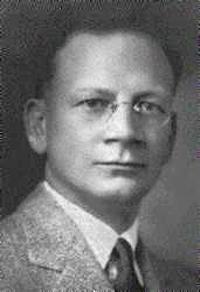
Edward R. Dewey (1895-1978)
In 1931 Edward R Dewey was appointed chief economics analyst for the U.S. Department of Commerce with the special task of finding out what had caused the market crash two years before. When he asked other economists what they thought the cause was he got as many different answers as there were economists, and found the most honest answer was “we don’t know.”
He was always a cautious man in reaching conclusions but found that there were cycles in many economic variables and that sometimes multiple cycles came together to cause especially large dips.
Dewey formed and became the President of the Foundation for the Study of Cycles (FSC) in 1942, an organisation which studied cycles in anything for which sufficient time span of reliable data could be found. Over the years he traced the varying cycles in stock market prices, the economy, wildlife abundance, prices of wheat, corn and cotton, precipitation, in wars, tree rings and fashion designs, and many, many more. Cycles were found with periods ranging from months to hundreds of years and several thousand cycles were recorded.
Dewey used simple techniques such as moving averages to highlight the cyclical aspect of any time series, and listened carefully to mathematicians and scientists so that he only presented conclusions that could be considered reliable ones. Most of the analysis was done by hand, computers only becoming accessible in his final years.
These cycles studies were published in Cycles magazine and in a book Cycles, The Mysterious Forces that Trigger Events (Hawthorn Books, Inc., New York, 1971) written together with Og Mandino. Later the best articles from Cycles magazine were collected together with a catalogue of cycles and this book and sold by FSC as the Classic Cycles Collection.
Some of the fundamental empirical laws of cycles found by Dewey over the years are:
- Common cycle periods appear in many seemingly unrelated disciplines.
- Cycles Synchrony is the observation that cycles of the same period often have the same phase.
- Cycles harmonic ratios is the observation that the common cycle periods are often related by ratios of 2, 3 and their products.
- Cycles outside the earth are related to cycles on earth. This was a conclusion that he came to reluctantly because it sounds like astrology.
Although the FSC continued after Dewey’s death it became more narrowly focussed on market cycles in the mid
1990s and went defunct in about 1996. The formation of the Cycles Research Institute in 2004 aimed to keep alive
the work of Dewey and other interdisciplinary cycles researchers for future generations, in the spirit of this
great pioneer.